
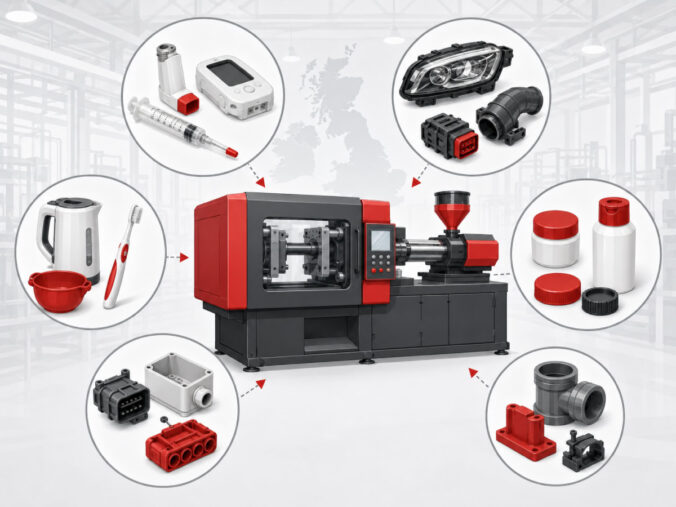
Injection moulding is the dominant process for producing plastic parts at scale in the UK and Ireland, used across nearly every manufacturing sector. The reason it shows up everywhere is straightforward: it produces precise, repeatable parts in a wide range of materials, scales economically from thousands to millions of units, and integrates well with downstream operations like printing, assembly and decoration. For most plastic parts produced in quantity, injection moulding is the default answer.
This guide tours the major UK and Irish end markets where injection moulding is the primary process. It covers what kinds of parts each sector typically produces, what makes injection moulding suited to that sector’s demands, and where to find a UK or Irish moulder with the right experience.
Medical devices & healthcare
The medical sector is one of the most demanding markets for injection moulding, and one where the UK and Ireland has particular strength. Typical parts include syringes, inhaler components, surgical instruments, diagnostic equipment housings, drug delivery devices, and a vast range of single-use consumables. Many of these parts are produced in cleanroom conditions and to ISO 13485 quality management standards.
Injection moulding suits the medical sector because the process can be validated to produce identical parts shot after shot, with full traceability and documentation. It also supports the wide range of medical-grade polymers required by different applications, from clear PETG for diagnostic devices to high-temperature engineering polymers for autoclavable instruments.
If your project involves medical, pharmaceutical or healthcare components, PlastikCity’s Medical & Cleanroom Moulding category lists UK and Irish specialists with the relevant certifications and cleanroom capabilities.
Automotive
Automotive is among the largest single sectors for UK and Irish injection moulding by volume. Typical parts span interior trim, exterior panels, lighting housings, under-bonnet components, electrical connectors, fluid reservoirs, and increasingly the components needed for electric and hybrid powertrains. The shift toward EVs has expanded what gets moulded for the automotive industry, with battery housings and charging components. With plastic parts reducing weight and fuel consumption compared to the metal parts they replace, lightweight structural parts are also growing in volume.
The sector’s demands are particular: long production runs, tight tolerances, IATF 16949 quality compliance, traceability across the supply chain, and increasing pressure on weight reduction. Injection moulding meets these demands at a unit cost that is hard to match with alternative processes.
Sector experience matters when sourcing for automotive work. PlastikCity’s Injection Moulding section lets you filter by capability and experience when submitting your specification.
Consumer products & household goods
The consumer products sector covers an enormous range: kitchen appliances, electronics housings, personal care products, kitchenware, toys, garden equipment, and the countless everyday objects most people pick up without thinking about how they were made. These are the applications most buyers can picture, and they are the bread and butter of UK injection moulding.
What distinguishes the consumer sector is the focus on cosmetic surfaces, colour matching, and often multi-material construction (a rigid outer shell with a soft-touch grip, for instance). Two-shot and overmoulded parts are increasingly common in consumer products as buyers expect higher levels of finish and integrated functionality.
If your part needs multi-material moulding, the Multi-Material and Twin Shot Moulding category covers UK specialists. For straight consumer-product moulding, the main Injection Moulding Companies listing covers the broader market.
Packaging
Packaging is a sector where injection moulding excels at very high volumes. Caps and closures, rigid containers, thin-walled food packaging, cosmetic packaging, and the closures and dispensers for personal care products are all typically injection-moulded. Many of these parts run on multi-cavity tooling at high speeds, with cycle times in the single seconds and outputs in the millions per year.
The packaging sector has its own regulatory framework, particularly for food contact (BRCGS, FDA, EU 10/2011) and child-resistant closures. UK packaging moulders are often set up specifically for the cycle speeds, cavitation counts and validation requirements that this sector demands.
For high-volume packaging projects, the Caps & Closures and Packaging Moulding category covers UK specialists in this work.
Electrical & electronics
Electrical and electronics is a sector where material properties often drive supplier selection more than volume. Typical parts include connectors, switches, enclosures, cable management, lighting components, and the housings for an enormous range of consumer and industrial electronics. Material requirements include flame retardancy, dimensional stability under temperature variation, dielectric properties, and often electromagnetic shielding through conductive compounds.
Moulders working in this sector typically have experience with engineering polymers like PBT, PC, PA66 and various flame-retardant grades, and with the tight tolerances that electrical contacts and connector geometries demand. Specifying the right material is often as important as specifying the right moulder.
If you need help with material selection alongside moulder selection, PlastikCity’s Material Warehouse covers UK polymer suppliers including specialist and compounded grades.
Industrial & construction
The industrial and construction sector covers a different end of the part spectrum: typically larger parts, often with lower cosmetic requirements, frequently in engineering polymers chosen for strength, chemical resistance or weather durability. Typical applications include pipe fittings, machine components, fixings, structural plastic parts, materials handling equipment, and the components used in commercial and industrial fitouts.
The volume requirements are lower than packaging or automotive but the parts are often larger, which can constrain machine size and tooling complexity. UK moulders working in this sector typically run larger presses and have experience with the engineering polymers (often glass-filled grades) that industrial applications demand.
For very large industrial parts, Structural Foam Moulding is a related process worth considering alongside conventional injection moulding.
When injection moulding might not be the right process
For all its versatility, injection moulding is not always the right answer. A short list of situations where another process is usually better suited:
- Very low volumes (typically under a few thousand parts per year). The tooling investment for injection moulding often does not pay back at low volumes, and low volume moulding companies or 3D printing are often more economical routes.
- Very large parts (hot water tanks, large containers, structural panels). Rotational moulding typically handles these more economically than injection moulding.
- Continuous profiles (pipe, tubing, sheet, weatherstrip). Extrusion is the right process for parts with a continuous cross-section.
- Soft elastomer parts (gaskets, seals, vibration mounts). Rubber moulding typically handles these.
If your project sits in one of these categories, the relevant PlastikCity category will point you toward the right specialists.
Finding the right UK moulder for your sector
For most plastic part projects, finding the right UK moulder is a matter of matching sector experience and capability to your specification. PlastikCity’s Source a Moulder section lets you submit your specification once, and it reaches vetted UK and Irish moulders whose capabilities match your requirements. They quote back directly, with no need to chase emails or send the same brief four different ways.
PlastikCity advertises only UK and Irish suppliers. PlastikCity has been established for over fourteen years and now brings together more than 260 vetted Partner companies across 400+ categories covering the UK and Irish plastics supply chain. It is free for buyers, and PlastikCity takes no commission on awarded contracts.
The short version
Injection moulding is the dominant process for plastic parts at scale across UK and Irish manufacturing, used in medical devices, automotive, consumer products, packaging, electrical components and industrial applications. For very low volumes, very large parts, continuous profiles or soft elastomer parts, other processes may suit better. Whichever route applies to your project, the relevant PlastikCity category lists the UK specialists who can quote on your work.