
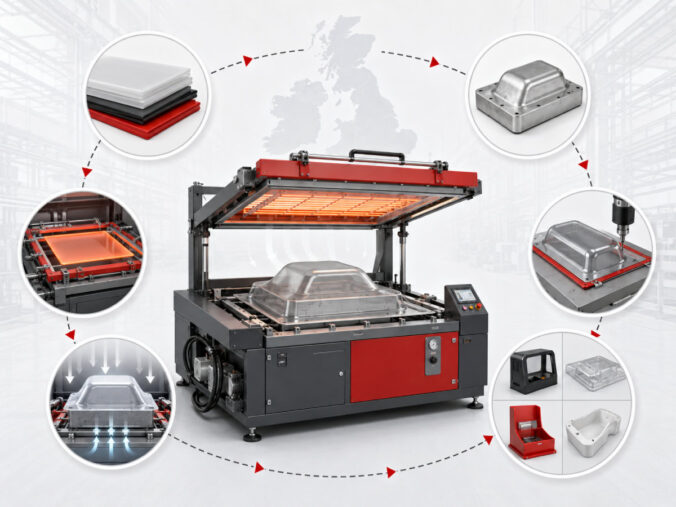
Vacuum forming is one of the most cost-effective ways to produce plastic parts, particularly for larger, thinner-walled components in lower volumes. It works by heating a sheet of plastic until it is soft, then drawing it down over a mould using vacuum so it takes the mould’s shape. The tooling is far simpler and cheaper than an injection mould, which makes vacuum forming the right answer for a whole category of parts where injection moulding would be uneconomical.
This guide explains what vacuum forming is, what it is best suited to, the materials and tooling involved, and how to find a UK vacuum forming supplier. It is aimed at buyers who already suspect vacuum forming might be right for their part, or who want to confirm it before sourcing.
How vacuum forming works
The process has four basic stages:
- A sheet of thermoplastic is clamped in a frame and heated until it becomes soft and pliable.
- The softened sheet is positioned over a mould (called a former or a buck).
- Air is drawn out from between the sheet and the mould, creating a vacuum. Atmospheric pressure pushes the soft sheet down onto the mould, where it takes the shape of the surface.
- The formed part cools, holds its shape, and is removed from the mould and trimmed to its final dimensions.
The simplicity of the process is the key to its economics. There is no high-pressure injection, no two-part steel tool, and no complex machine. That simplicity is what makes vacuum forming so cost-effective for the parts it suits.
What vacuum forming is best suited to
Vacuum forming earns its place for parts that share certain characteristics:
- Larger parts. Where an injection mould for a large part would be very expensive, a vacuum forming tool for the same part is a fraction of the cost. The bigger the part, the stronger the case for vacuum forming.
- Thinner walls. Vacuum forming produces parts with relatively thin, fairly uniform walls. It is not suited to thick or solid sections.
- Lower to medium volumes. The low tooling cost means vacuum forming pays back at much lower volumes than injection moulding. For short and medium runs of larger parts, it is often the most economical process available.
- Simpler geometries. Vacuum forming suits open shapes, trays, covers and shells. It is not the process for complex three-dimensional parts with intricate features on all sides.
If your part is large, relatively shallow or shell-like, has thin walls, and is needed in lower volumes, vacuum forming deserves serious consideration.
Typical UK applications
Vacuum forming is used across a wide range of UK sectors. Common applications include:
- Machine guards and equipment housings
- Point-of-sale displays and retail fixtures
- Packaging trays and blister packs
- Automotive interior panels and trim, particularly for specialist and low-volume vehicles
- Medical equipment housings and covers
- Bath and shower trays, and other sanitaryware
- Refrigeration liners and appliance components
- Ducting, cowlings and protective covers
The common thread is parts that are relatively large, have a defined front face, and do not need the dimensional precision or complex geometry that would push them toward injection moulding.
Materials commonly used in vacuum forming
Vacuum forming works with most thermoplastic sheet materials. The most common in UK use are:
- ABS for tough, impact-resistant parts like machine guards and housings
- HIPS (high-impact polystyrene) for cost-sensitive parts and packaging
- PETG for clear or food-contact applications
- Polycarbonate for high-impact, high-temperature or optically clear parts
- Acrylic (PMMA) for clear parts where appearance matters
- Polypropylene for chemical resistance and living-hinge applications
The choice of material depends on the part’s end use: impact resistance, temperature exposure, clarity, chemical contact and cosmetic finish all influence which sheet material is appropriate. A vacuum forming supplier can advise on grade selection based on the application.
Tooling for vacuum forming
The tooling is where vacuum forming’s cost advantage is clearest. A vacuum forming mould is a single former, not a two-part steel tool, and it can be made from a range of materials depending on the volume:
- Timber, MDF or composite tooling for prototypes and very low volumes. Cheap and quick to produce, with limited life.
- Resin or cast tooling for low to medium volumes, offering a good balance of cost and durability.
- Aluminium tooling for medium to higher volumes, where the tool will see repeated use and benefits from the temperature stability and durability that machined aluminium provides.
Because the tool is single-sided and made from softer materials than an injection mould, it is dramatically cheaper to produce and much faster to make. This is the central reason vacuum forming suits lower volumes: the tooling investment is a fraction of what injection moulding requires.
How vacuum forming compares to thermoforming & pressure forming
The terminology here is worth clarifying because it is often used loosely. Thermoforming is the umbrella term for any process that heats a plastic sheet and forms it over a mould. Vacuum forming is the most common type of thermoforming, using vacuum alone to draw the sheet down.
Two related processes are worth knowing about:
- Pressure forming adds positive air pressure on the opposite side of the sheet, pushing it onto the mould more forcefully than vacuum alone. This produces sharper detail, crisper edges and better surface finish, making it suitable for parts that need a more refined appearance than standard vacuum forming gives. It costs more than vacuum forming but less than injection moulding.
- Twin-sheet forming forms two sheets simultaneously and bonds them at the edges to produce a hollow part, useful for items like fuel tanks, pallets and double-walled containers.
For most parts, standard vacuum forming is the right starting point. If your part needs sharper detail or a higher-quality cosmetic finish, it is worth asking a supplier whether pressure forming would suit the application better.
How to brief a UK vacuum former
The more complete your brief, the more accurate the quotes you will receive. A useful vacuum forming brief includes:
- A drawing or CAD model of the part, or a sample if one exists
- The material, or a description of the performance requirements if you are unsure
- The required wall thickness or thickness range
- The annual volume and order pattern
- Any cosmetic requirements (surface finish, colour, texture)
- Trimming requirements and tolerances on the trimmed edges
- Any regulatory requirements (food contact, fire rating, medical)
With that information in hand, a UK vacuum former can give you an accurate quote and advise on material and tooling choices for your volume.
Finding a UK vacuum forming supplier
For most vacuum forming projects, the practical challenge is finding suppliers set up for your part size and volume, then getting comparable quotes from them. PlastikCity’s Vacuum Forming Companies category lists vetted UK and Irish suppliers who work across the range of vacuum forming applications, from prototypes to production runs.
If you are still comparing vacuum forming against other moulding processes, the Injection, Blow, or Rotational Moulding comparison may help, and for larger hollow parts the Source a Moulder section covers the full range of processes.
PlastikCity advertises only UK and Irish suppliers. PlastikCity has been established for over twelve years and now brings together more than 260 vetted Partner companies across 400+ categories covering the UK and Irish plastics supply chain. It is free for buyers, and PlastikCity takes no commission on awarded contracts.
The short version
Vacuum forming heats a plastic sheet and draws it over a single-sided mould using vacuum. The simple, low-cost tooling makes it the most economical process for larger, thinner-walled parts in lower to medium volumes: machine guards, displays, trays, panels, housings and covers. It works with most thermoplastic sheet materials, and for parts needing sharper detail, pressure forming is a related option worth asking about. When vacuum forming is right for your project, PlastikCity’s Vacuum Forming Companies category connects you to vetted UK and Irish suppliers.