
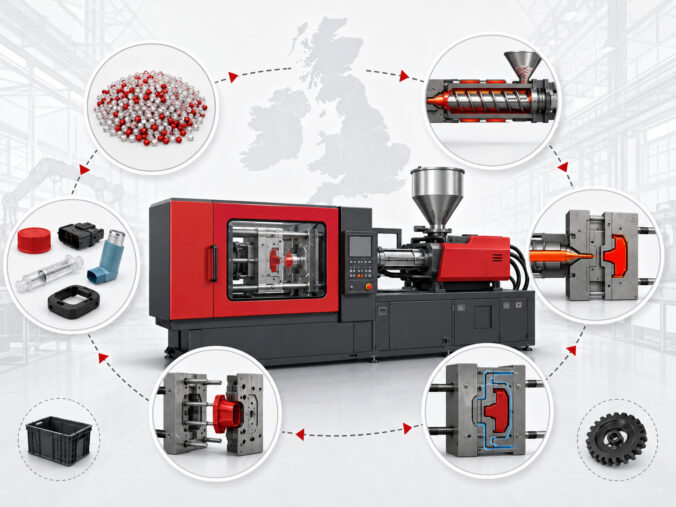
Injection moulding is the manufacturing process behind most plastic parts produced in quantity. The keyboard you are typing on, the bottle caps in your kitchen, the casing of your TV remote, the dashboard of your car, the syringes used in your last hospital visit: all of these are almost certainly injection-moulded. The process is the workhorse of plastics manufacturing, and across the UK and Ireland it produces enormous quantities of parts every year in factories from Aberdeen to Cornwall.
This guide is for UK and Irish buyers who want to understand injection moulding properly: what it is, how it works, what gets made with it, when it is the right process for a project, and what alternatives exist when it isn’t. It assumes no prior knowledge of plastics manufacturing. If you are completely new to the topic, start here and work through. If you already know the basics, the later sections on choosing the right process and routing to UK moulders may be more useful.
The basics: what injection moulding actually is
Injection moulding is a process for producing plastic parts by forcing molten plastic into a steel mould, letting it cool, and removing the finished part. The mould is the tool that gives the part its shape; the moulding machine is the equipment that melts the plastic and forces it into the mould under pressure. The same tool can produce identical parts shot after shot for the life of the tool, which is what makes injection moulding the dominant process for any plastic part produced in volume.
The process has six basic stages, repeated for every part:
- Plastic granules are fed into a heated barrel where they melt.
- A screw inside the barrel pushes the molten plastic toward the mould.
- The molten plastic is injected into the closed mould at high pressure, filling the cavity.
- The plastic cools inside the mould and solidifies into the part’s shape.
- The two halves of the mould open, and the part is ejected (by mechanical ejector pins or a robot).
- The mould closes and the cycle begins again.
A complete cycle typically takes between a few seconds (for thin-walled packaging parts running on multi-cavity tools) and several minutes (for thick-walled structural parts). The faster the cycle, the more parts come off the machine per hour, which directly affects the unit cost.
The mould tool
The mould tool is a precision-engineered steel block, machined to the exact inverse shape of the part. It has two halves that come apart along a parting line, with a hollow cavity that defines the part shape when the halves close together. A typical tool weighs anywhere from a few hundred kilograms (for a small single-cavity tool) to several tonnes (for a large multi-cavity production tool).
The tool is the most expensive single component in an injection moulding project. A tool for a small consumer part is a relatively modest capital investment; a tool for a complex automotive or medical part can be substantially larger. This is a one-off investment, amortised across the production run. The longer the production run, the smaller the tooling cost per part.
Tool design is a specialist discipline. Most UK and Irish moulders work with established injection mould toolmakers, either in-house or through long-term partnerships. The choice of toolmaker matters as much as the choice of moulder, because a well-designed tool runs cleanly for the life of the project, while a poorly-designed tool causes ongoing problems that no amount of process optimisation can fully resolve.
The full mechanics of tool design (cavitation, gating, cooling, draft, ejection) are beyond the scope of this guide, but the practical thing to understand is that the part design and the tool design are closely linked. Decisions made about the part early on (wall thickness, draft angles, undercuts, gate position) drive what the tool has to do, which drives the cost.
The injection moulding machine
The moulding machine itself is a substantial piece of industrial equipment, typically several metres long and weighing many tonnes. Three sections matter for understanding how it works:
- The injection unit is where plastic granules are fed in, melted, and pushed forward by a rotating screw. The screw both meters the right quantity of plastic for each shot and forces it through the nozzle and into the mould.
- The clamping unit holds the two halves of the mould together with enormous force during injection (sometimes hundreds of tonnes) so the high-pressure molten plastic does not push the mould apart.
- The control system governs every variable: melt temperature, injection speed, hold pressure, cooling time, ejection timing. UK injection moulding shops typically run highly automated machines with extensive process monitoring, often supplied by specialist injection moulding machine suppliers covering all-electric, hydraulic and hybrid technologies.
Moulders typically operate machines in several different size categories, from small presses (under 100 tonne clamping force, used for small parts) up to very large machines (over 1,000 tonne, used for large parts like automotive bumpers or industrial containers). The right machine size for a part depends on the part’s size, the projected pressure during injection, and the size of the tool.
Materials used in injection moulding
One of injection moulding’s strengths is the breadth of materials it can process. Moulders typically work across:
- Commodity polymers like polypropylene (PP), polyethylene (PE in HDPE and LDPE forms), polystyrene (PS) and ABS. These are the high-volume workhorses, used for packaging, household products, toys and many consumer goods.
- Engineering polymers like polyamide (PA, often called nylon), polycarbonate (PC), polyoxymethylene (POM, often called acetal), and PBT. These offer higher mechanical performance, better temperature resistance, or specific properties like transparency, and are used in automotive, electrical, and engineering applications.
- Specialist polymers including medical grades, high-temperature polymers like PEEK, conductive compounds for ESD applications, flame-retardant grades for electrical components, and food-contact-approved variants of many materials.
- Sustainable and recycled grades including mechanically recycled content, chemically recycled content, and bio-based polymers, which are increasingly used as buyers respond to sustainability requirements and the Plastic Packaging Tax.
Most moulders source base polymers from specialist polymer suppliers and compounders. Where colour or specific additives are needed in smaller quantities, these are often added at the moulding machine using masterbatch, rather than buying a fully pre-compounded grade. Material choice typically happens alongside part design rather than separately, because the two interact closely. A clear material specification is one of the most useful things a buyer can bring to a quote.
What gets made with injection moulding
Injection moulding shows up across nearly every UK manufacturing sector. A short tour of the main applications:
- Medical devices and healthcare: syringes, inhalers, surgical instruments, diagnostic equipment housings, drug delivery devices. Often produced in cleanroom conditions to ISO 13485 standards by specialist UK medical and cleanroom moulders.
- Automotive: interior trim, exterior panels, lighting housings, under-bonnet components, electrical connectors, increasingly the components needed for electric vehicles. Long production runs, tight tolerances, IATF 16949 quality compliance.
- Consumer products: kitchen appliances, electronics housings, personal care products, toys, garden equipment, kitchenware. The familiar applications most people see every day.
- Packaging: caps and closures, rigid containers, thin-walled food packaging, cosmetic packaging. High-volume, fast-cycle work, typically running on multi-cavity tools, produced by UK caps, closures and packaging moulders set up for the cavitation counts and cycle speeds the sector demands.
- Electrical and electronics: connectors, switches, enclosures, cable management, lighting components. Material properties (flame retardancy, dimensional stability, dielectric performance) often drive supplier selection.
- Industrial and construction: pipe fittings, machine components, fixings, structural plastic parts. Often larger parts in engineering polymers chosen for strength, chemical resistance or durability.
The breadth is part of why injection moulding dominates UK plastics manufacturing. The same fundamental process serves syringes and car bumpers, with different machine sizes, different materials and different tooling approaches for each.
Variations of the injection moulding process
Beyond the standard process, several specialist variations have evolved to handle particular requirements. These are still injection moulding at their core, but with different process tweaks or machine configurations.
Structural foam moulding uses a small amount of chemical blowing agent or gas to create micro-cellular foaming within thicker walls. This reduces weight and cycle time while allowing larger parts with varying wall sections. Often used for industrial housings, machinery components and large covers. Structural foam moulders are typically set up for larger parts than standard injection moulders.
Gas injection moulding injects an inert gas (typically nitrogen) into the molten plastic core of thicker sections of the part. The internal gas pressure prevents shrinkage marks on the outer surface and can hollow out thicker sections, reducing weight. Useful for parts with thick walls that need a high cosmetic finish. Gas injection specialists work across automotive and furniture applications among others.
Multi-material and two-shot moulding uses a machine with two or more independent injection units to combine different plastic materials or colours into a single part. The classic example is a toothbrush with a soft-touch grip moulded over a rigid core, or a power tool handle with a hard outer shell and a soft grip insert. Multi-material moulding specialists handle two-shot, multi-shot and co-injection variants.
Insert moulding and overmoulding combine a plastic moulded part with a second component, typically a metal insert (insert moulding) or a previously-moulded plastic part (overmoulding). Examples include screwdriver handles moulded around a metal shaft, or gear knobs with a soft outer layer over a hard inner core. Insert and overmoulding specialists work across automotive, electrical and consumer products.
Medical and cleanroom moulding is standard injection moulding carried out in a controlled environment to reduce contamination. Cleanrooms range from white rooms (basic contamination control) up to ISO Class 7 and 8 cleanrooms (strict particle counts, air filtration, restricted access). Required for medical devices, pharmaceutical components and some sensitive electronics. Medical and cleanroom moulders hold ISO 13485 and related certifications.
Liquid silicone rubber (LSR) moulding uses silicone elastomer rather than thermoplastic, with two-part liquid silicone mixed and injected into a heated mould where it cures. LSR has excellent temperature resistance, biocompatibility and dielectric properties, making it suitable for medical, healthcare, cookware and automotive parts. LSR moulders are a specialist sub-set of the injection moulding industry.
When is injection moulding the right process for your project?
For most plastic parts produced in meaningful volume, injection moulding is the default answer. The economic and quality advantages over alternative processes typically dominate once a project moves beyond the prototyping stage.
Injection moulding is usually the right process when:
- Volume is meaningful. The tooling investment pays back across the production run. As a rough guide, projects with annual volumes in the thousands and above usually benefit from injection moulding; projects with volumes in the hundreds may find other processes more economical.
- The part needs to be consistent. Injection moulding produces identical parts shot after shot, with full traceability and process validation possible for regulated work.
- The part has reasonable geometry. Most three-dimensional shapes can be moulded, with the main constraint being that the part has to release from the tool cleanly.
- The material is a thermoplastic. Most plastic materials can be injection moulded. The main exceptions are thermoset materials (handled by compression moulding) and some highly filled or specialty materials.
Injection moulding is often not the right process when:
- Volumes are very low. A few hundred parts, or one-off prototypes, often suit 3D printing or low volume moulding better, because the tooling investment for full injection moulding does not pay back at that scale.
- The part is very large. Hot water tanks, large containers, industrial waste bins and similar parts are typically produced by rotational moulding, which handles large hollow parts more economically.
- The part has a continuous cross-section. Pipes, tubing, profiles and weatherstrip are made by extrusion, which produces continuous lengths rather than discrete parts.
- The part is hollow with a fixed shape. Bottles, containers and other hollow parts are typically made by blow moulding.
- The part is a thin sheet or formed-from-sheet shape. Trays, packaging, point-of-sale displays and machine guards are often vacuum-formed rather than injection moulded.
Choosing the right process is one of the earliest decisions in any plastic part project, and getting it right matters because changing process after tooling has been invested in is expensive.
What does injection moulding cost?
Injection moulding costs break down into six components: tooling, material, cycle time, machine hourly rate, order volume, and any post-mould operations like assembly or decoration. The relative weight of each depends on the part and the volume. For most parts, machine time is the largest single component, followed by material, with tooling amortisation becoming small at higher volumes.
The full picture of how moulding costs work is covered in a separate piece, Plastic Injection Moulding Costs Explained. The short version: the headline unit price is rarely the full picture, and understanding which cost component dominates for your specific part is the most useful starting point for any conversation with a moulder.
How to find a UK or Irish injection moulder
For most projects, the bottleneck in finding a moulder is not the search itself but getting three or four genuinely comparable quotes without spending two weeks chasing emails. PlastikCity’s Source a Moulder section was built specifically for this step. Submit one specification, and it reaches the vetted UK and Irish moulders whose capabilities match your requirements. They quote back directly.
The most useful categories for an injection moulding project are typically:
- Injection Moulding Companies for general-purpose moulding work
- Medical & Cleanroom Moulding for medical, pharmaceutical or cleanroom-produced parts
- Low Volume Moulding Companies for projects with annual volumes too small for general-purpose moulders
- Injection Mould Toolmakers for tooling sourced separately from the moulder
- Product Designers & Developers for projects that need design work before a moulder can quote
PlastikCity advertises only UK and Irish suppliers. PlastikCity has been established for over twelve years and now brings together more than 260 vetted Partner companies across 400+ categories covering the UK and Irish plastics supply chain. It is free for buyers, and PlastikCity takes no commission on awarded contracts.
Further reading
For deeper dives into specific aspects of injection moulding sourcing, the following blog posts may be useful:
- How to Choose an Injection Moulding Company in the UK & Ireland: what to check, what to ask, how to compare quotes
- Plastic Injection Moulding Costs Explained: the six cost components and how to read a quote
- Injection, Blow, or Rotational Moulding: a three-way comparison of the major plastic moulding processes
The short version
Injection moulding is the manufacturing process behind most plastic parts produced in quantity. Molten plastic is forced into a steel mould, cooled, and ejected; the cycle repeats for the life of the production run. The process is the dominant choice for plastic parts in the UK and Ireland because of its precision, repeatability, material range and economic scaling. It suits most plastic parts produced in meaningful volume, with alternative processes (rotational moulding, blow moulding, vacuum forming, 3D printing, extrusion) better suited to specific cases. When injection moulding is the right answer for your project, PlastikCity’s Source a Moulder section connects you to vetted UK and Irish moulders with one submission rather than four separate emails.